
If your AC just quit on a 91-degree Orange Park afternoon, the first question on your mind isn’t how the compressor works. It’s what the repair is going to cost — and whether it’s worth fixing at all. This guide breaks down real Florida prices for every common AC repair in 2026, why those prices look the way they do in Clay County specifically, and how to tell when repair stops making sense.
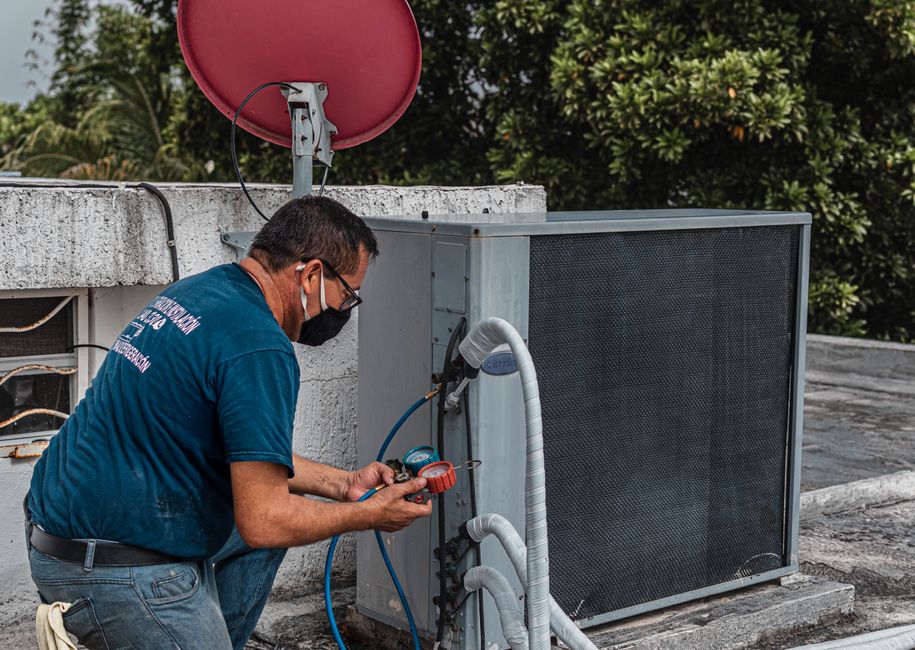
Most AC repairs in Orange Park run between $150 and $750, with a diagnostic fee of $75–$200 on top (often credited toward the repair if you approve it). A simple capacitor or contactor swap is the low end. Compressor or evaporator coil work pushes into the thousands. Full system replacement at 2026 SEER2 minimums starts around $7,000.
Orange Park sits in a climate band that is brutal on air conditioners. Most cost guides written for the rest of the country don’t apply here, and pretending they do leads homeowners into bad budgeting and worse equipment decisions.
A typical AC in Orange Park runs roughly 2,500 to 3,500 hours per year. In Ohio or Michigan, that same system would run 1,000 to 1,500 hours. Cooling season here is effectively 10 to 12 months long. Components designed for 15 years of moderate use are getting compressed into 8 or 10 years of near-constant duty cycles, and the failure timeline moves up accordingly. Homeowners worried about long summer bills can find practical fixes in our guide to reducing AC energy bills in Orange Park.
Average July highs in Orange Park sit around 91°F with humidity holding between 75% and 81% through summer. Proximity to the St. Johns River and Atlantic moisture keeps relative humidity above 70% for most of the year. That forces evaporator coils into continuous moisture-removal duty, which accelerates coil corrosion and biological growth, and keeps condensate drain lines constantly active — which is why clogged drains are the single most common service call HVAC companies field across the Jacksonville metro.
From June 1 through November 30, every outdoor condenser in Clay County is exposed to flying debris, power surges, and storm-surge flooding. A few inches of standing water around the unit can corrode electrical components and ruin motors beyond economical repair. Systems that have been submerged should never be powered back on without a technician inspecting them first.
Below are the repairs Orange Park homeowners actually pay for, with Florida-specific 2026 price ranges. Labor in the Jacksonville metro sits at the middle to upper end of national averages because of equipment access, humidity-rated parts, and runtime stress on systems. For a broader look at what causes most failures, our Ponte Vedra AC repair primer walks through the same failure modes seen across the metro.
These three account for most service calls in Clay County:
These are the repairs that trigger the repair-versus-replace conversation:
For context, a full 3-ton system replacement — the size most Clay County homes need given a median home footprint of about 1,977 square feet — runs $7,000 to $10,500 at the SEER2 code minimum for the Southeast region, with higher-efficiency systems and ductwork changes pushing past $13,000.
There’s a point where pouring money into an aging system stops making sense. The math isn’t complicated, but it does require honesty about the unit’s age. If you’re weighing it now, our Orange Park HVAC system replacement guide lays out the full repair-vs-replace decision tree.
The traditional rule: multiply the repair cost by the age of the unit in years. If the result exceeds $5,000, replacement is usually smarter. Equipment prices have climbed enough in 2025–2026 that the threshold has effectively moved to $6,000 or $7,000, but the principle holds. A $1,200 compressor repair on an 8-year-old unit produces $9,600 — well past the line. The same repair on a 3-year-old unit comes in at $3,600 and is an easy yes.
Another check: a typical repair runs 20–30% of the cost of a full replacement. When a repair quote starts approaching half the cost of a new system, the long-term math favors replacement, especially given the runtime hours Florida systems accumulate.
Florida residential AC systems typically last 10 to 15 years, with coastal and high-humidity units often falling to 6 to 10 years. Orange Park sits about 15 miles inland, so salt-corrosion effects are buffered relative to Mayport or Atlantic Beach, but the humidity load alone keeps systems in the lower half of that range without consistent maintenance. The Department of Energy notes that proactive upkeep improves efficiency by up to 15%, and ENERGY STAR’s maintenance checklist is the cleanest reference for what that actually means season to season.
A few specific Orange Park realities that change the cost math in 2026.
As of January 1, 2025, the EPA’s AIM Act prohibits new residential AC and heat pump systems using refrigerants with a global warming potential above 700. That retires R-410A from new equipment in favor of R-454B, a low-GWP A2L refrigerant. The transition created supply chain pressure through the 2025 cooling season — cylinder prices spiked sharply, and refrigerant-related repair costs in Florida rose accordingly. Existing R-410A systems can still be serviced and recharged; you just won’t see R-410A in new installs going forward.
Between June 1 and November 30, the cheapest repair is the one you prevent. Strap or secure the outdoor condenser pad if you’re in a flood-prone part of Clay County. Cut the power at the disconnect if a major storm is forecast. After a storm, don’t restart the system if water reached the unit — a technician needs to inspect first. Flood-driven AC replacements in the Jacksonville area routinely run $3,500–$7,500 for the outdoor unit alone, more if the air handler or ductwork was affected.
Under Florida Statute Chapter 489, any AC install, removal, or replacement requires a licensed HVAC contractor and a building permit — including like-for-like change-outs. The Clay County Building Division administers permits through the Tyler Technologies EPL portal for properties in unincorporated Clay County. Properties inside the incorporated Town of Orange Park pull permits through the town’s own Building Inspections & Permitting Division, not the county portal. Mechanical permits over $15,000 — common on full system replacements with ductwork — require a recorded Notice of Commencement at the Clay County Courthouse before the first inspection.
Florida is one of the worst places in the country to size an AC by rule of thumb. The old “one ton per 600 square feet” math undersizes most Orange Park homes by half a ton or more once you factor in actual humidity load, ductwork, insulation, and window orientation. ACCA Manual J is the ANSI-recognized standard for residential load calculations and is referenced by national building codes. Any contractor who refuses to discuss Manual J before quoting a replacement is a contractor worth getting a second opinion on.
AC repair costs in Orange Park run higher than the national average because Florida systems work harder than systems anywhere else in the country. Capacitor and drain-line repairs stay affordable. Compressor, coil, and refrigerant work gets expensive fast. The honest decision rule is straightforward: small repair on a younger system, fix it. Big repair on an aging system, get a replacement quote next to the repair quote and run the numbers.
Hot Heads HVAC handles AC repair and installation in Orange Park and serves homeowners across Orange Park, Ponte Vedra, Mandarin, St. Johns, World Golf Village, Nocatee, Julington Creek, Durbin, Palencia, and St. Augustine — throughout Clay County and the wider Jacksonville metro. If your AC is acting up or you’re trying to decide whether to repair or replace, get a diagnostic done before the next heat wave forces the decision for you.